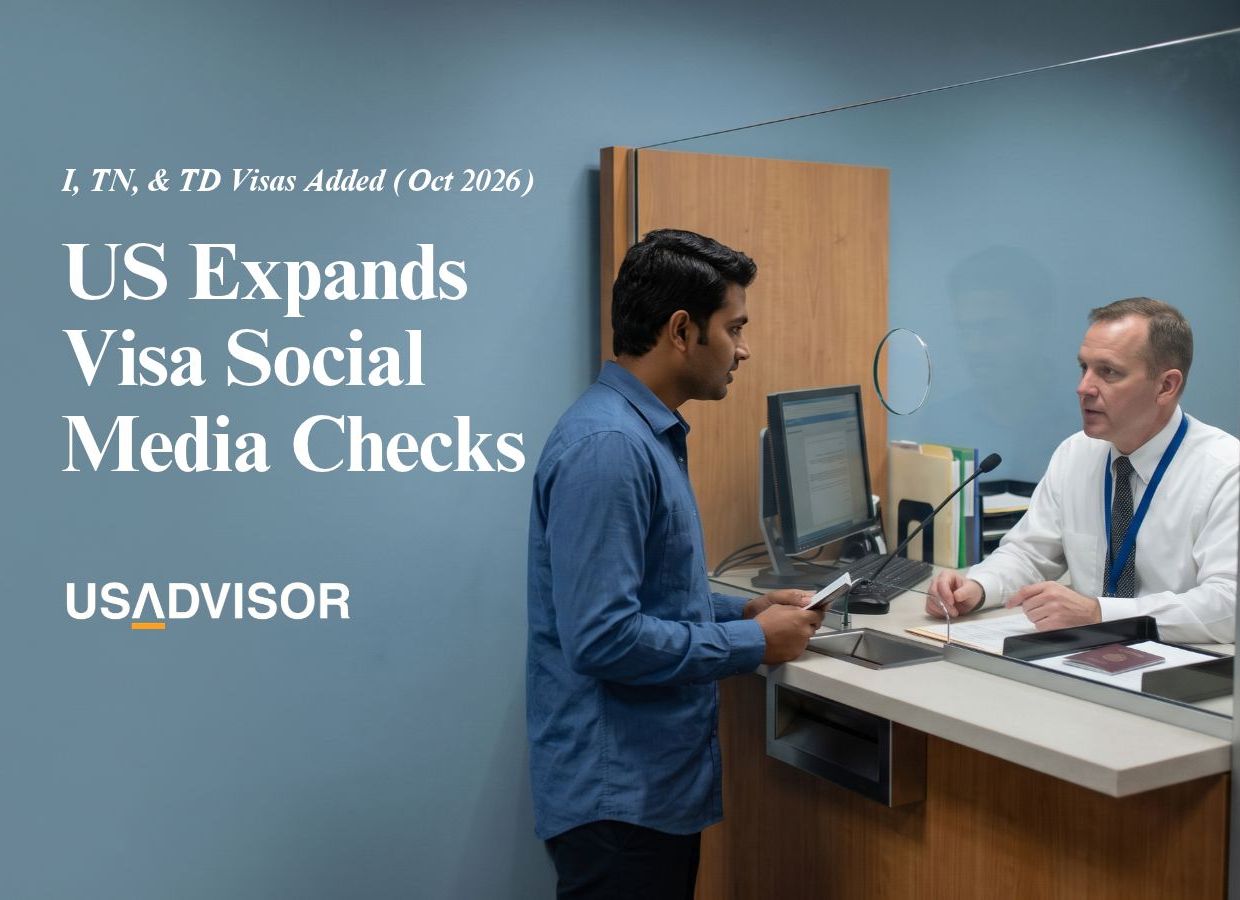
Breaking: U.S. Expands Mandatory Social Media Vetting to I, TN, and TD Visas Starting October 1
The U.S. State Department is rapidly closing the gap between your physical paperwork and your digital footprint. In a notice updated on September 18, 2026, the U.S. government announced a major expansion of its mandatory “online presence review”.
Starting October 1, 2026, applicants for I, TN, and TD visas will be legally required to set their privacy settings on all social media profiles (including LinkedIn, X, Instagram, and Facebook) to “public” or “open” to facilitate consular review.
At US Advisor, we constantly monitor how policy shifts affect consular decision-making psychology. The message from the U.S. government is clear: your digital life is now a core component of your admissibility. Here is exactly what this new rule means, who is targeted, and how you must strategize your digital profile moving forward.
What Exactly is Changing on October 1?
Until recently, certain professional categories were exempt from the rigorous digital vetting applied to students and tech workers. That changes on October 1. The mandate requires the following applicants to open their online presence to U.S. officials:
- I Visas (Foreign Media Representatives): This directly impacts Indian and international journalists, reporters, film crews, and media professionals traveling to the U.S. for news gathering or educational media operations.
- TN Visas (USMCA Professionals): Eligible Canadian and Mexican citizens taking up temporary professional work in the U.S..
- TD Visas (Dependants): The spouses and unmarried minor children accompanying TN visa holders.
If you apply under these categories, a consular officer will actively review your public social media history to verify that your online conduct aligns with the professional intent stated on your DS-160 application.
The Consular Psychology: Why is the U.S. Doing This?
The State Department has been incredibly blunt about the reasoning behind this expansion: “Receiving a U.S. visa remains a privilege granted at the government’s discretion, not an entitlement”.
From a psychological standpoint, every US visa adjudication is treated fundamentally as a national security decision. Consular officers are trained to look for “intent fraud” and public safety risks. If a foreign journalist claims they are entering the U.S. to cover a technology conference, but their public social media feed is filled with anti-U.S. extremism or contradicts their stated employer, the visa will be immediately refused.
Who is Already Under the Social Media Microscope?
If you are an Indian professional or student, do not assume you are exempt just because you aren’t applying for an I or TN visa. The government has been steadily rolling out this digital vetting regime over the last year:
- June 2025: Vetting began for F-1 and M-1 students, as well as cultural exchange participants on a j1 visa.
- December 2025: Expanded to H-1B tech workers and their H-4 dependants.
- March 2026: Broadened to cover a massive sweep of categories including A, C, G, H-3, K, Q, R, S, T, and U visas.
With I, TN, and TD categories now added to the list, nearly the entire non-immigrant visa ecosystem is subject to open-profile scrutiny.
The US Advisor Strategy: How to Protect Your Profile
The days of treating your visa application and your social media as two separate entities are over. This new mandate introduces supplementary procedural complexity and will likely extend official processing times.
To survive this heightened scrutiny, you must execute the following strategies immediately:
- Conduct a Digital Audit: Before you even book your interview, review your entire public timeline. Ensure your stated employment, educational background, and travel history online perfectly match what you submitted in your DS-160. Discrepancies equal denials.
- Anticipate Delays: Because officers now have to manually review digital communications, processing times and 221(g) administrative holds will increase. If your travel is time-sensitive, you need to rely on specialized protocols to secure an urgent us appointment long before your intended departure date.
- Recovering from Vetting Refusals: If your visa was denied because an officer found a perceived inconsistency in your digital footprint, you cannot simply reapply and hope for the best. We use specific frameworks for refusal people to apply again, focused on addressing the exact red flag the officer flagged and correcting the narrative.
The U.S. visa process is no longer just a 60-second window interview—it is a comprehensive audit of your professional and digital life. Ensure your profile signals the absolute highest level of clarity, intent, and compliance.
Does your digital footprint match your visa intent? Click here to book a strategic profile evaluation with US Advisor today.
Also read H-1B Visa Fraud Crackdown Act Oct 2026 | US Suspends Microsoft, Infosys, TCS from Green Card Program (Oct 2026) | H-1B Extensions Now “Fresh Cases”