The Era of Easy Extensions is Dead: Why Your H-1B Renewal is Now a “Fresh Case”
If you are an H-1B worker, an H-4 spouse, or holding any work authorization in the United States, the playbook just completely changed.
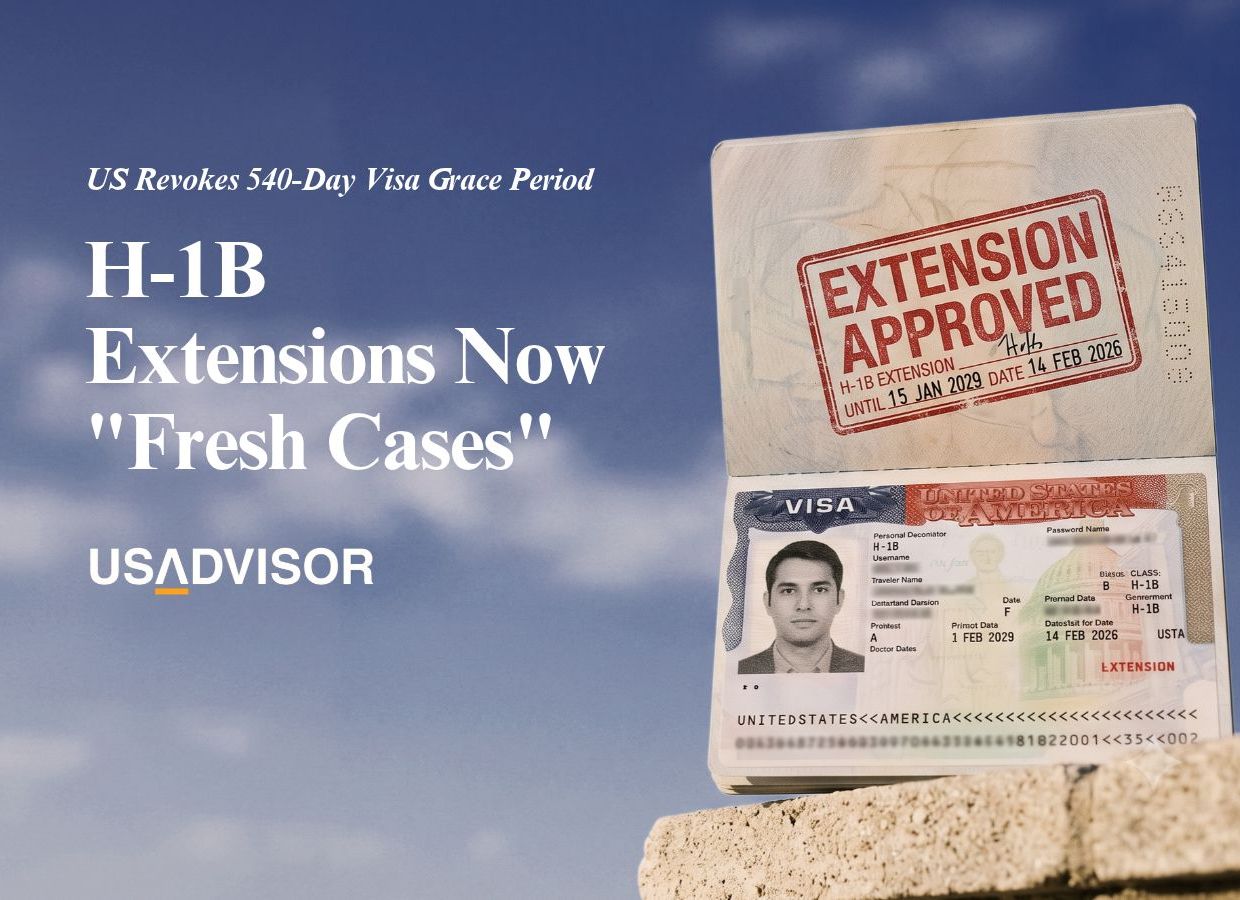
The Department of Homeland Security (DHS) has officially published a new rule in the Federal Register (effective October 14) that radically tightens how the U.S. government handles visa extensions. The new policy eliminates the Biden-era 540-day automatic extension for pending renewals. Even worse, U.S. Citizenship and Immigration Services (USCIS) will no longer give “deference” to past approvals—meaning every single H-1B extension will now be treated as a brand-new, fresh case.
At US Advisor, we don’t look at policy changes as isolated events; we analyze the psychology of the adjudicating officers. This dual-action rule change is designed to create friction. Here is exactly what is happening, who is impacted, and the strategic steps you must take to protect your U.S. employment.
Threat 1: The End of the 540-Day Grace Period
Previously, if your Employment Authorization Document (EAD) expired but you had a renewal application pending, the government granted you a massive 540-day automatic extension. This protected workers from losing their jobs due to USCIS processing delays.
The DHS has now made an interim rule permanent: that grace period is gone.
If your work permit expires while your renewal is still stuck in the USCIS backlog, you instantly lose your legal right to work. As of June 2026, over 432,000 work permit renewals were pending in the backlog. Because you cannot apply to renew until 180 days before expiration, thousands of asylum seekers, H-4 spouses, and temporary workers are about to face abrupt employment termination simply because the government is processing paperwork too slowly.
Threat 2: H-1B Extensions Treated as “Fresh Cases”
This is the most dangerous psychological shift for high-skilled Indian professionals.
Historically, if you had an approved H-1B and applied for an extension with the same employer for the same job, USCIS officers would defer to the original approval. They trusted that if you were qualified before, you are qualified now.
That trust is officially revoked.
By treating every extension as a “fresh case,” the USCIS officer is required to re-evaluate your entire profile from zero.
- They will question if your job is still a “specialty occupation.”
- They will scrutinize your exact wages, daily duties, and your employer’s right of control over your work.
This guarantees a massive surge in Requests for Evidence (RFEs) and outright denials. Officers are looking for any minor inconsistency between your original petition and your new extension filing.
The US Advisor Strategy: How to Survive the New Scrutiny
Whether you are holding an H-1B, an H-4 EAD, or even preparing for a j1 visa exchange program, this culture of aggressive, zero-trust scrutiny is bleeding into every single US visa category. You can no longer assume that past success guarantees future approval.
To survive this crackdown, you and your employer must adopt a defensive posture:
1. Re-Audit Your Job Duties Before Filing
Do not just copy and paste your job description from three years ago. Your extension petition must be a bulletproof, modernized document that decisively proves your role requires highly specialized, degree-specific knowledge.
2. File on Day 180
Because the 540-day grace period is gone, time is your biggest enemy. You are legally allowed to file your renewal 180 days before your current document expires. You must have your entire petition finalized and submitted on exactly that 180th day. Do not wait for day 179.
3. Navigate the Stamping Backlog
If your extension somehow gets snarled in processing and you must travel back to India, you will face severe consular delays for re-stamping. Do not leave your return to chance. Use established, professional protocols to secure an urgent us appointment so you are not stranded outside the U.S. while your job is at risk.
4. Strategy for H-1B Refusals
If you fall victim to this new “fresh case” policy and receive an unexpected denial, panic will not save you. A denial is simply the officer stating your paperwork lacked a clear narrative. We specialize in mapping these exact failure points, providing a structured recovery framework for refusal people to apply again with a successfully restructured petition.
The U.S. government has changed the rules of the game. Your paperwork must be flawless, and your intent must be unassailable.
Is your extension approaching, or have you recently been hit with a complex RFE? Click here to book a strategic evaluation with US Advisor today.