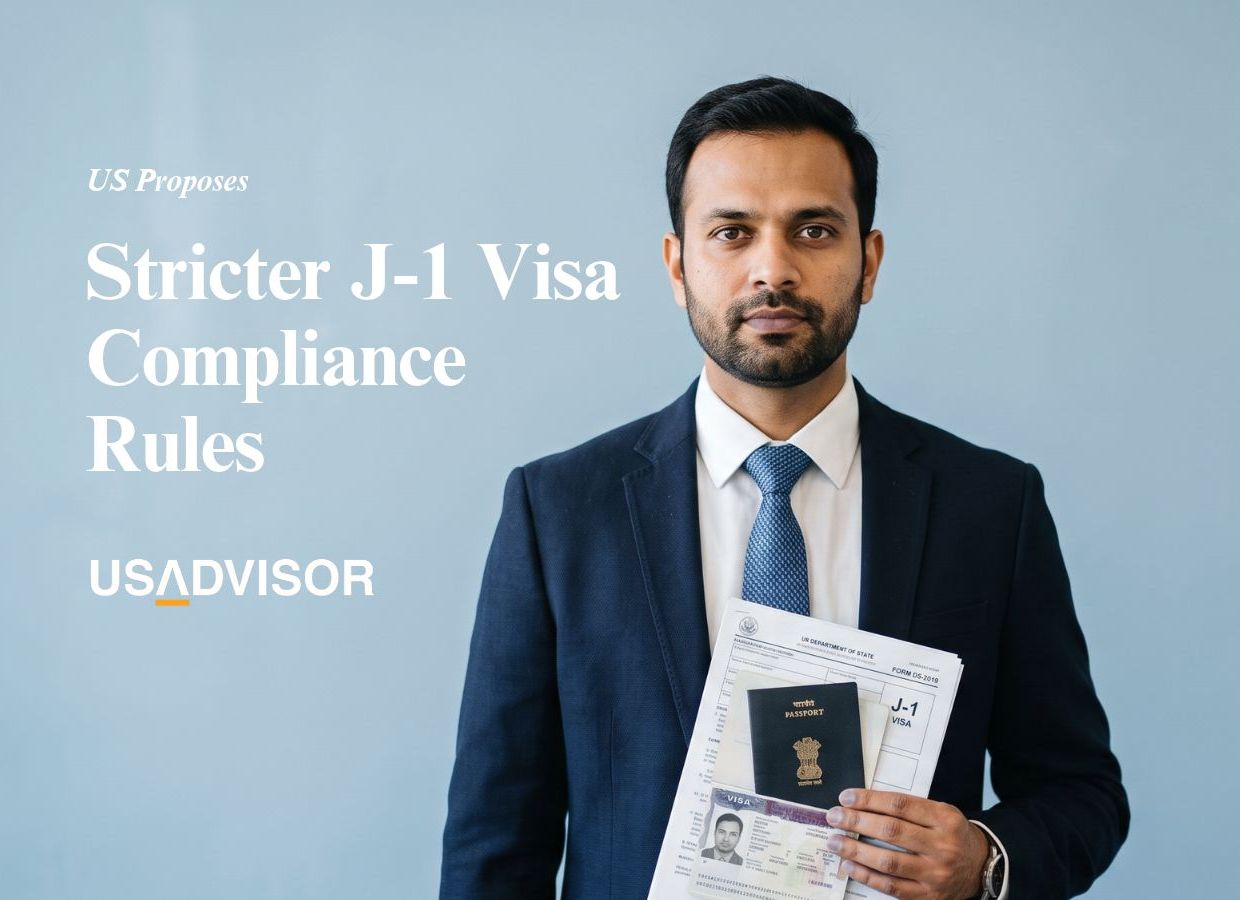
The U.S. immigration landscape is tightening once again—and this time, the focus has shifted from corporate work visas directly to academic, medical, and research exchange programs.
Following the recent Department of Homeland Security (DHS) rule that replaces the decades-old “Duration of Status” (D/S) system with fixed admission periods of up to four years, the U.S. Department of State (DOS) has just published a sweeping new proposed rule in the Federal Register.
This new proposal introduces stricter compliance requirements, expands the grounds for program termination, and imposes heavy monitoring duties on U.S. universities and teaching hospitals.
With over 12,000 J-1 visas issued to Indian nationals in fiscal year 2024 alone, thousands of Indian postdoctoral researchers, scientists, professors, and medical residents heading to the U.S. must understand what is changing—and why strategic preparation is now more critical than ever.
4 Major Changes in the Proposed J-1 Visa Rule
Unlike the H-1B employment visa, the J1 visa
is designed for educational, medical, and cultural exchange. While the new DOS proposal does not change the initial eligibility criteria, it drastically changes how you must maintain your status once you arrive in the U.S.:
1. A Comprehensive Definition of “Failure to Maintain Status”
Currently, rules governing a J-1 visitor’s legal status are scattered across multiple regulations. The proposed rule consolidates these into a single, strict framework. You can now officially fall out of status for:
Even an inadvertent failure to maintain exact, mandatory health insurance coverage for yourself or your J-2 dependents.
Engaging in any unauthorized employment.
Failing to meet specific daily or weekly program activities.
Overstaying your authorized program period.
2. Expanded Grounds for Immediate Program Termination
The DOS is broadening its authority to terminate an individual’s participation in the Exchange Visitor Program. In addition to basic rule violations, grounds for termination will now explicitly include specified criminal conduct, fraud or misrepresentation, and national security concerns.
Crucially, sponsors are now required to terminate participants who provide false or incomplete information during their application process or while enrolled.
3. Codified Reinstatement Rules
For the first time, the DOS is formally writing out the exact eligibility criteria, required documentation, and legal procedures for reinstatement if an exchange visitor accidentally falls out of status. While this creates transparency, it also means the government will follow a rigid, unforgiving checklist when reviewing reinstatement requests.
4. Heavy Compliance Burden on Sponsoring Institutions
U.S. universities, research institutions, and hospitals will now be required to monitor J-1 participants much more closely, report any eligibility changes immediately into SEVIS, and enforce strict termination rules. Your sponsor is no longer just your host—they are legally obligated to act as your compliance auditor.
The US Advisor Strategic Angle: The Psychology of Compliance
At US Advisor, we don’t just look at immigration updates as legal paperwork—we guide step by step.
Why is the State Department making these moves right now? Because consular officers and program auditors are trained to look for intent discrepancies and compliance drift.
When an Indian doctor or postdoctoral researcher applies for a US visa, consular officers are now evaluating whether the applicant has the discipline, clarity, and transparency to survive under a zero-tolerance compliance regime.
- No Room for Ambiguity: Whether it is your proof of U.S. address, your academic qualifications, or your funding documentation, a single inconsistency can now trigger a mandatory termination by your sponsor.
- Past Refusal Scrutiny: If you are among the many refusal people to apply who have faced a past 214(b) or 221(g) rejection, your reapplication narrative must be 100% watertight. Consular officers will cross-examine your past DS-160 filings against your current exchange goals to spot any exaggeration.
How to Protect Your Exchange Visitor Journey
The public comment period for this proposed rule runs for 60 days before it is officially finalized. However, U.S. consulates are already operating with heightened scrutiny. If you are preparing for a research fellowship, medical residency, or university exchange, you must take a strategic approach:
- Audit Your Profile Before You Submit: Ensure every document—from your DS-2019 to your financial sponsorship letters—matches your verbal interview answers flawlessly.
- Prepare for Interviewing: Know how to clearly explain your research or medical scope without sounding rehearsed or evasive.
- Plan Your Timelines Early: With strict compliance checks and backlog pressures, waiting until the last minute can ruin your start date. If your program start date is approaching rapidly and you are struggling to secure a consular slot, explore our guidance on navigating an urgent us appointment strategically.
Navigating a Complex J-1 Case or Past Refusal?
Do not let stricter compliance rules derail your academic or medical career in the United States. Whether you are applying for the first time or trying to overcome a previous visa denial, US Advisor brings over a decade of expertise and 1,000+ successful case analyses to protect your future.
Schedule Your Strategic Profile Evaluation with us today