US Demands Up to $20,000 Visa Bond from 50 Countries: Why India is Exempt & What It Means for You
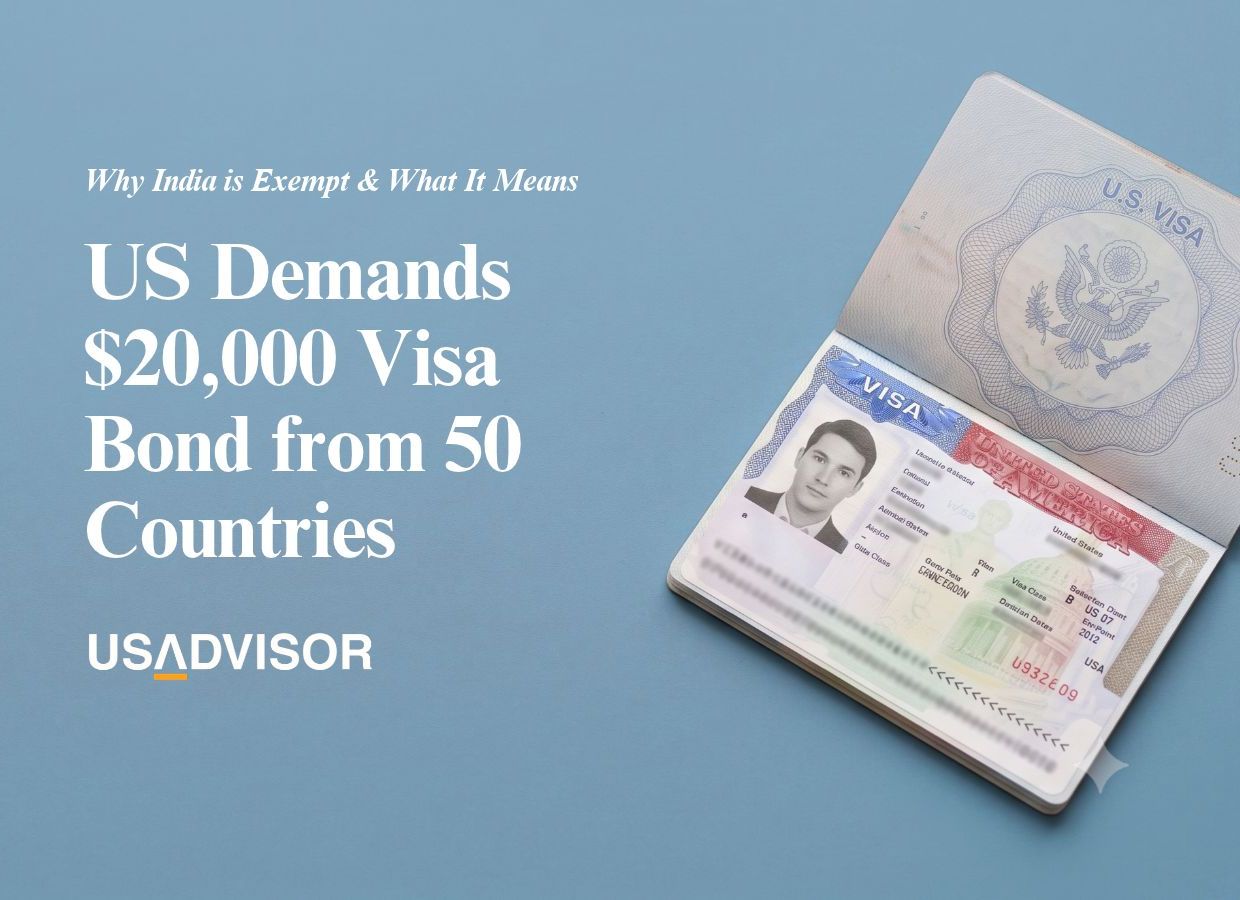
The United States government is aggressively closing the gaps in its immigration system. In a sweeping new mandate finalized by the U.S. Department of State, travelers from 50 designated countries must now post a financial bond of up to $20,000 just to secure a B1/B2 tourist or business visa.
If you are an Indian passport holder, I have excellent news: India has been completely exempted from this list. However, our immediate neighbors—including Bangladesh, Nepal, and Bhutan—are facing the full force of this new financial hurdle.
At US Advisor, we look past the headlines to understand the consular psychology driving these decisions. This new mandate is a massive indicator of how aggressively the U.S. is prosecuting “intent fraud.” Here is our strategic breakdown of the new visa bond program, how it works, and why your profile presentation is more critical than ever.
Why Did the US Introduce the Visa Bond Program?
To understand this rule, you have to understand the visa officer’s greatest fear: the overstay.
Under Section 221(g)(3) of the Immigration and Nationality Act (INA), the government has the authority to demand a financial guarantee before issuing a visa. The State Department analyzed the Department of Homeland Security’s entry/exit overstay reports and identified 50 countries with unacceptably high rates of B1/B2 travelers who entered the U.S. and simply never left.
The psychology is straightforward: if a traveler is forced to deposit up to $20,000 of their own money, they are heavily incentivized to comply with the terms of their visa and return home on time.
How the $20,000 Visa Bond Actually Works
This is not a blanket fee that everyone pays upfront. It is a highly targeted enforcement mechanism. Here are the exact parameters of the program:
- The Target Categories: The bond applies only to B1 (Business) and B2 (Tourism/Medical) visa applicants. If you are applying for a work visa (H-1B) or an exchange program on a j1 visa, you are completely exempt from this specific bond.
- The Financial Tiers: If a consular officer determines that you are a flight risk but otherwise eligible, they can demand a bond of $10,000, $15,000, or $20,000.
- The Payment Process: The bond cannot be paid directly to the embassy. You must submit DHS Form I-352 and pay the exact amount via the U.S. Treasury’s official portal, Pay.gov. (Warning: Scammers are already creating fake payment portals. Never pay a bond unless explicitly directed by the consular officer).
- The Refund: It is a bond, not a tax. If you travel to the U.S., follow the rules, and depart on a commercial flight before your authorized stay expires, the bond is fully canceled and returned to you.
- The Forfeiture: If you overstay your visa, attempt to change your status illegally, or claim asylum, the U.S. government keeps your $20,000.
The India Exemption: A Massive Advantage
While 50 nations across Africa, the Caribbean, Asia, and the Pacific are now burdened with this financial guarantee, the exclusion of India is a testament to the overall compliance rate of the Indian professional diaspora.
However, do not mistake this exemption for leniency. Just because Indian citizens do not have to post a $20,000 bond does not mean the consulates in Mumbai, Delhi, or Hyderabad are handing out approvals freely. Consular officers are applying extreme scrutiny to every single applicant to ensure they do not become an overstay statistic.
The US Advisor Strategy: Protect Your Profile
If you are an Indian national applying for a standard US visa, your intent must be flawless. You do not have the luxury of using a $20,000 bond to “prove” you will return home—your profile, your documents, and your spoken interview answers must do the heavy lifting.
- Clear Purpose: Vague travel plans are the number one trigger for a 214(b) rejection. Your narrative must be specific, logical, and instantly verifiable.
- Strategic Refiling: If you have been rejected in the past, the system already views you as a high-risk applicant. You cannot simply reapply with the same DS-160. We deploy specialized frameworks for refusal people to apply again, completely restructuring the presentation of their home ties.
- Beat the Backlog: With increased scrutiny comes increased processing delays. If you have critical corporate travel approaching, you cannot afford to wait in the standard 10-month queue. Leverage our professional protocols to secure an urgent us appointment efficiently and legally.
The U.S. immigration system is rapidly evolving. Stop relying on outdated advice and internet rumors.
Are you ready to secure your approval with a bulletproof strategy? Click here to book a strategic profile evaluation with US Advisor today.
Also read H-1B Visa Fraud Crackdown Act Oct 2026 |